Labiba® FlowAvailable for projects

Labiba® FlowComplete the work. Stop chasing it.

Request & approval management

An intelligent platform for requests, approvals and workflow automation that connects people, data, documents and systems in one journey from request to outcome.

Designed for: Government and private-sector organisations, shared services, HR, finance, procurement and operations teams that need visible, measurable request and approval journeys.

Labiba® Flow
An everyday example · Flow

You know what you need and want to submit and track it

Illustrative example, not a delivered client case. Steps, connected systems and permissions are defined for each project.

What do you ask?
I want to request a work computer and see where my request stands.

Your request follows the route your organization has defined: manager review, then the IT team, with a clear status at each step.

What do you get?

A recorded request, a clear status and a known owner for the next step.

  1. Complete the computer request

    Enter the required information in the form and add attachments if needed.

  2. Send it to the right reviewer

    In this example, the manager reviews it and, if approved, it goes to IT according to the organization’s agreed process.

  3. Check progress without chasing messages

    See whether it is awaiting approval, being prepared or complete. If returned for changes, see the reason.

A familiar problem

You ask several colleagues whether the manager approved the request and whether IT has received it.

What becomes clearer in your day?

Know the next step and its owner, then return to your work with a clear view of your request.

Another use

An invoice needs review before payment

The need
An employee submits a supplier invoice with the required attachments.
How does the product help?
The responsible department reviews it, then sends it to finance or returns it with the missing information noted, following the agreed route. Status and comments stay with the request.
The practical result
The requester knows what is needed and who is reviewing it. Completed approvals do not automatically transfer money without agreed integration and permissions.

The difference in one sentence

Compare all three examples

You do not necessarily need all three products. These examples explain their roles; they do not imply ready-made integration between them or exclusive functions.

Is this the product you need?

When to choose it

Request & approval management

When a process has known forms, steps and approvers, and you need to see where every request stands.

Important boundaries

What should not be assumed?

Your organisation defines the workflow rules and approvers. Actions in another system depend on approved integration and permissions.

Delivery and what we confirm before a demonstration

The product is delivered through a project defining use, configuration, integration and handover. Equipment, deployment and support are specified according to need.

Before the demonstration, we confirm what can be shown and what needs preparation for your scenario.

  • A sample or scenario from your work and an agreed acceptance criterion; do not send sensitive data through the contact form.
  • Included functions, licences, devices and integration, and anything quoted separately.
  • Setup, operation and support costs, schedule assumptions and both parties' responsibilities.
How is cost determined?
Product capabilities

Connected capabilities around one operating journey

Adaptive request forms

Builds adaptive request forms around the service, required information and attachments.

Visual workflow designer

Designs sequential or parallel approvals, conditions, committees and exceptions in a visual workflow.

Context-rich review and approval

Keeps the request, documents, comments, changes and decision context together for the reviewer.

Service targets and escalation

Tracks service targets, warns before delay and supports delegation, substitutes and approved escalation.

Governed AI assistance

Uses governed AI to summarise requests and attachments, extract fields, detect gaps and suggest classification while retaining authorised human decisions.

Operational analytics

Connects cycle time, waiting, returns, service targets and reviewer workload to the requests that explain each metric.

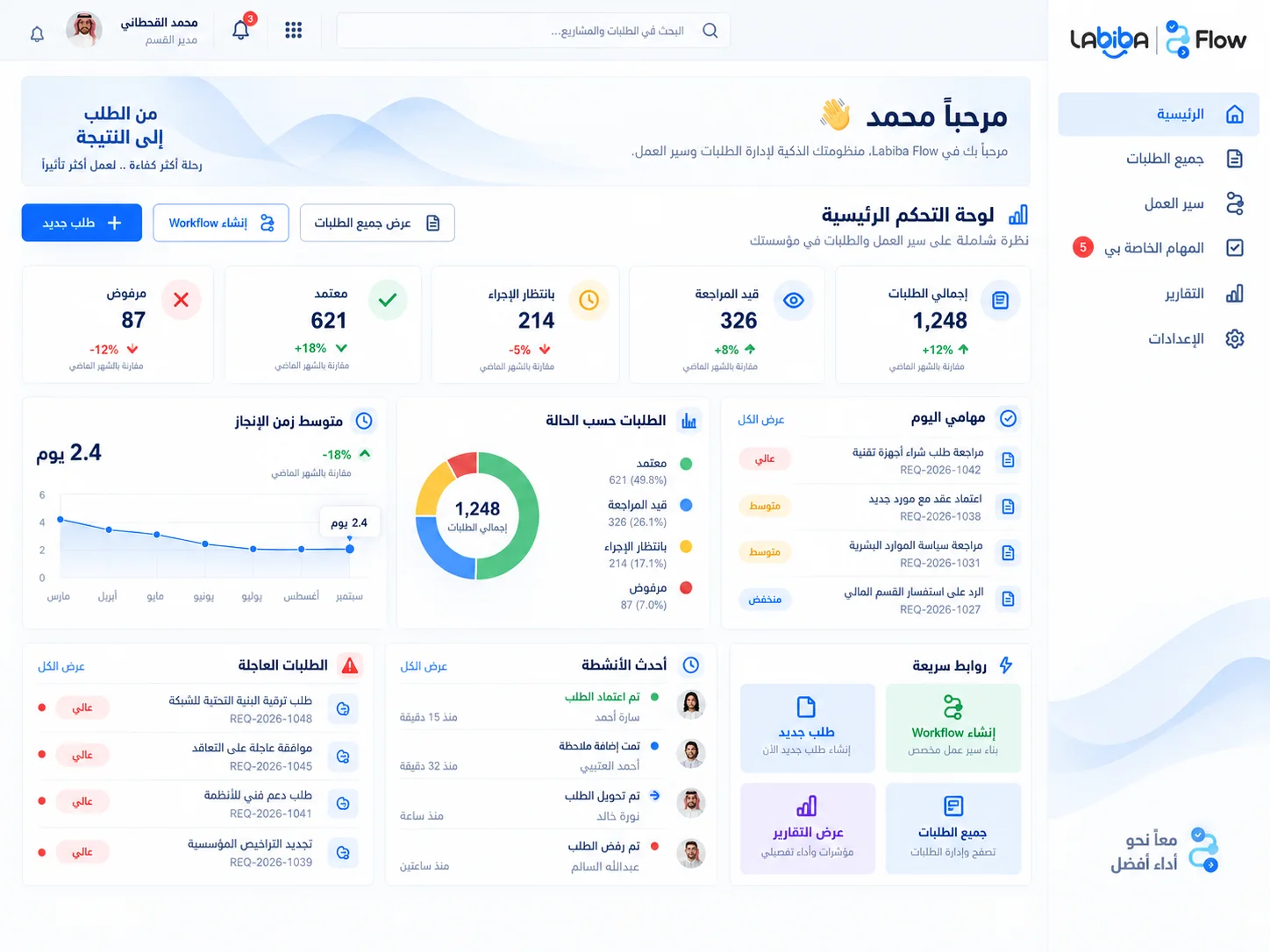
Real product interface

See the product in operation

Labiba® FlowComplete the work. Stop chasing it.
How to start

How to start

We validate the operating context, scope and dependencies before recommending the configuration.

  1. 01Describe the need and users
  2. 02Review systems and data
  3. 03Define scope and acceptance
  4. 04Agree deployment and support
After the scope is approved

After the scope is approved

The product moves through a governed delivery journey, not a software licence alone.

  1. 01Configuration
  2. 02Integration and validation
  3. 03Acceptance testing
  4. 04Training and go-live
  5. 05Support and improvement

Integration and security

Interfaces, access, retention, environment and responsibilities are documented within the agreed scope.

Trust & procurement center
A clear first step

Evaluate Labiba® Flow in your environment

Share the need, users and relevant systems. We will recommend a demo, scoped project or solution path according to the product and context.